


There is a question that has been quietly reshaping the education economy for the last several years, and most people who monetize their expertise have not stopped long enough to actually sit with it.
If anyone can learn almost anything for free, what are people actually paying for?
This is not a philosophical exercise. It is the operating reality of 2026. Large language models like ChatGPT, Claude, and Gemini can teach you more than most online courses. They can give you customized advice for your specific situation. They can answer your follow-up questions instantly. YouTube has become the largest free university in human history, with world-class tutorials on virtually every subject you can name.
The cost of accessing information has collapsed to near zero. And yet people are still spending money on education. In many cases, more money than before.
The thing they are paying for is not what most people think it is. Understanding this distinction is what separates the experts who build real income from the ones who keep launching products no one finishes.
Here is the uncomfortable truth about the online course industry.
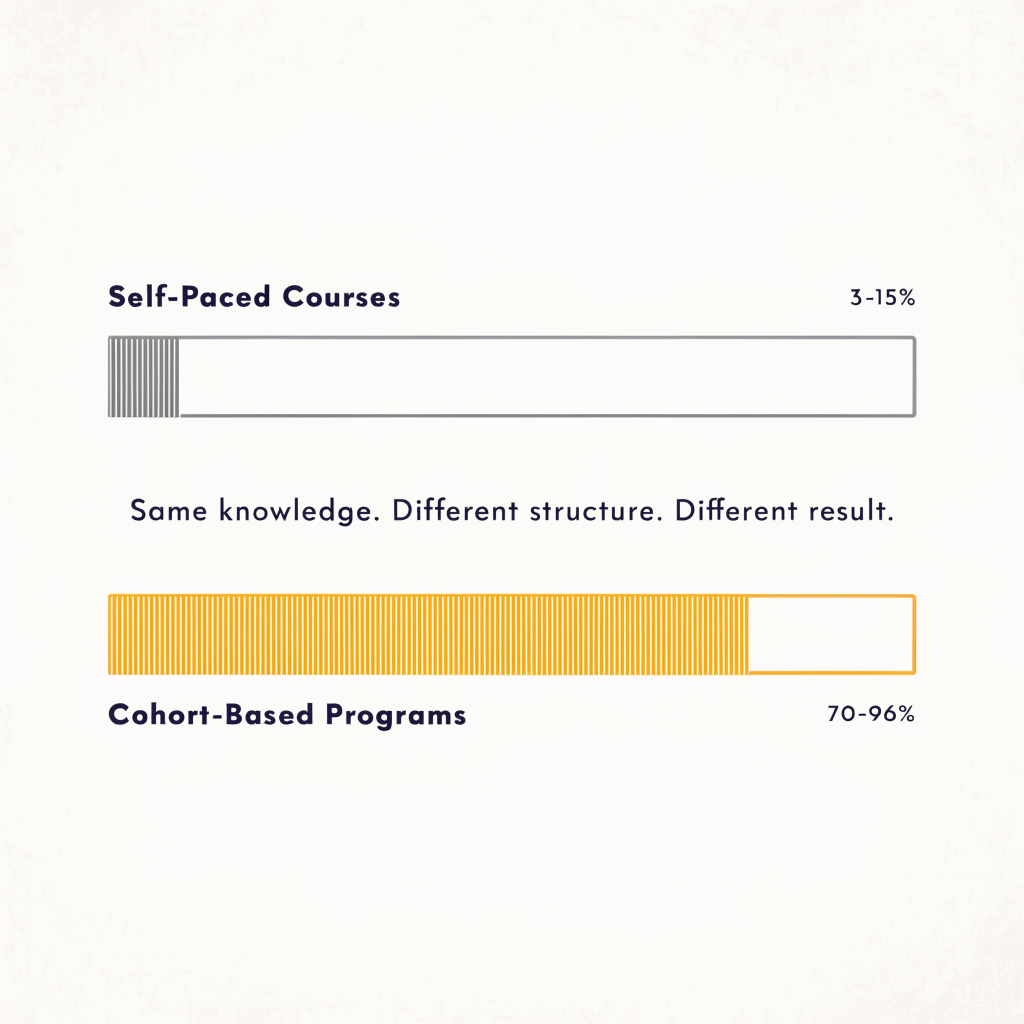
Most people never finish the courses they buy. The data on this is not ambiguous. Self-paced online courses have completion rates that hover between 3 and 15 percent across virtually every major study conducted in the last decade. MIT published research showing that their MOOCs had a completion rate of just over 3 percent between 2017 and 2018. Udemy, one of the largest course platforms in the world, reports an 8 percent completion rate from their best-performing instructors. Harvard and MIT’s joint research found that more than half of registrants never even opened the first lecture.
These numbers are not anomalies. They are the structural reality of self-paced digital education. And they have consequences that go far beyond the buyer’s experience.
When your students do not finish your course, they do not get results. When they do not get results, they do not recommend you to anyone. When they do not recommend you, your next launch depends entirely on your ability to find new cold audiences. When you are perpetually hunting for new buyers instead of being carried by word of mouth from people who actually succeeded, your business is on a treadmill. You are running harder to stay in the same place.
The course model was built for an era when access to information was itself the value proposition. That era is over. The value proposition has migrated somewhere else entirely, and most people have not followed it.
What people actually pay for now is not knowledge. It is the environment that makes them execute the knowledge.
This is a distinction that sounds subtle but changes everything about how you design and sell an educational product. The problem your customer has in 2026 is almost never that they lack information. Their problem is that they have too much information and no structure to act on any of it. They have 47 browser tabs open. They have saved three courses they never started. They have a notes app full of ideas they have not touched in months. They know what to do. They do not do it.
The solution to that problem is not more content. It is structured accountability delivered in a live, time-bound, group environment.
That is what a cohort-based course is. And it is, I believe, the most underutilized and highest-performing format available to anyone who wants to turn expertise into income right now.
A cohort is a live, time-bound group program where a set of students go through material together on a fixed schedule. As opposed to a self-paced course where people log in whenever and work alone, a cohort creates structural forces that drive completion without relying on the buyer’s willpower.
When students are on a shared timeline, they cannot fall behind silently. When there is a live session on Tuesday, they show up on Tuesday or they watch the recording knowing everyone else has already moved ahead. When there is a community channel, they see peers posting progress, which creates social pressure to keep pace. When homework has a deadline, it gets done.
None of those forces exist in a self-paced course. In a self-paced course, the only accountability mechanism is the buyer’s discipline. And discipline, left to its own devices, is not a system. It is a wish.
The data reflects this. Programs with cohort structures, live support, and community see completion rates between 70 and 96 percent. Harvard’s altMBA, a four-week cohort teaching soft skills traditionally covered in a two-year MBA program, reports a 96 percent completion rate. Esme Learning’s cohort programs report 98 to 100 percent. When Harvard transitioned its case-method courses to incorporate peer collaboration, completion climbed to 85 percent while most of their MOOCs remained in the single digits.
The difference between 5 percent completion and 90 percent completion is not content quality. It is the format itself. The structure is doing the work.
This model is not new. That is one of the most important things to understand about it.
Every university in the world runs on cohorts. Every military training program. Every professional certification worth its weight. Every bootcamp that actually produces people who can do the job on day one. Harvard Executive Education charges $15,000 for a six-week cohort. The format has been the backbone of structured education for over a century because it works at a level that self-paced learning simply does not reach.
What changed is not the model. What changed is who can run one.
Until recently, you needed institutional backing, physical infrastructure, and administrative support staff to operate a cohort. Now you need a laptop, a Zoom account, and an audience of any size. The barrier to entry collapsed while the format’s effectiveness remained exactly where it has always been. That gap between low barrier and high performance is where the opportunity sits right now, and almost no one in the creator and expert economy is taking it seriously.
On Maven alone, the largest dedicated platform for cohort-based courses, over 12 instructors have crossed a million dollars in revenue and over 100 have crossed $100,000. Ship 30 for 30, a writing cohort that helps people publish 30 pieces in 30 days, has done over $10 million in lifetime revenue on a single, focused outcome. Building a Second Brain by Tiago Forte, a cohort that teaches people to organize their digital notes and research, has generated between five and ten million dollars. Ali Abdaal’s Part-Time YouTuber Academy has cleared $5 million helping people launch a YouTube channel and publish their first video.
Each of these programs delivers one specific outcome over a short, defined timeline. That narrowness is not a limitation. It is the design principle that makes them work.
If you are sitting on expertise worth monetizing, whether from a career, a craft, a transformation you have been through, or a skill people regularly ask you about, the cohort format gives you a structural advantage that no other model offers right now. Here are four principles that separate a well-built cohort from a live course that just happens to have a start date.
The first principle is transformation over education.
A cohort is not a course with a schedule attached to it. A cohort exists to help a specific group of people achieve one tangible result in a short period of time. The emphasis is on the word “achieve.” You are not selling information transfer. You are selling outcome delivery.
That outcome should be simple enough to state in one sentence and achievable within four to six weeks. “Publish 30 pieces of online writing in 30 days.” “Launch your YouTube channel and publish your first video.” “Build your first income system and make your first sale in 30 days.” Each of those is a clear, verifiable transformation. If your outcome description requires a paragraph of explanation, it is too complex. Narrow it down until a stranger can understand what they will have accomplished by the end.
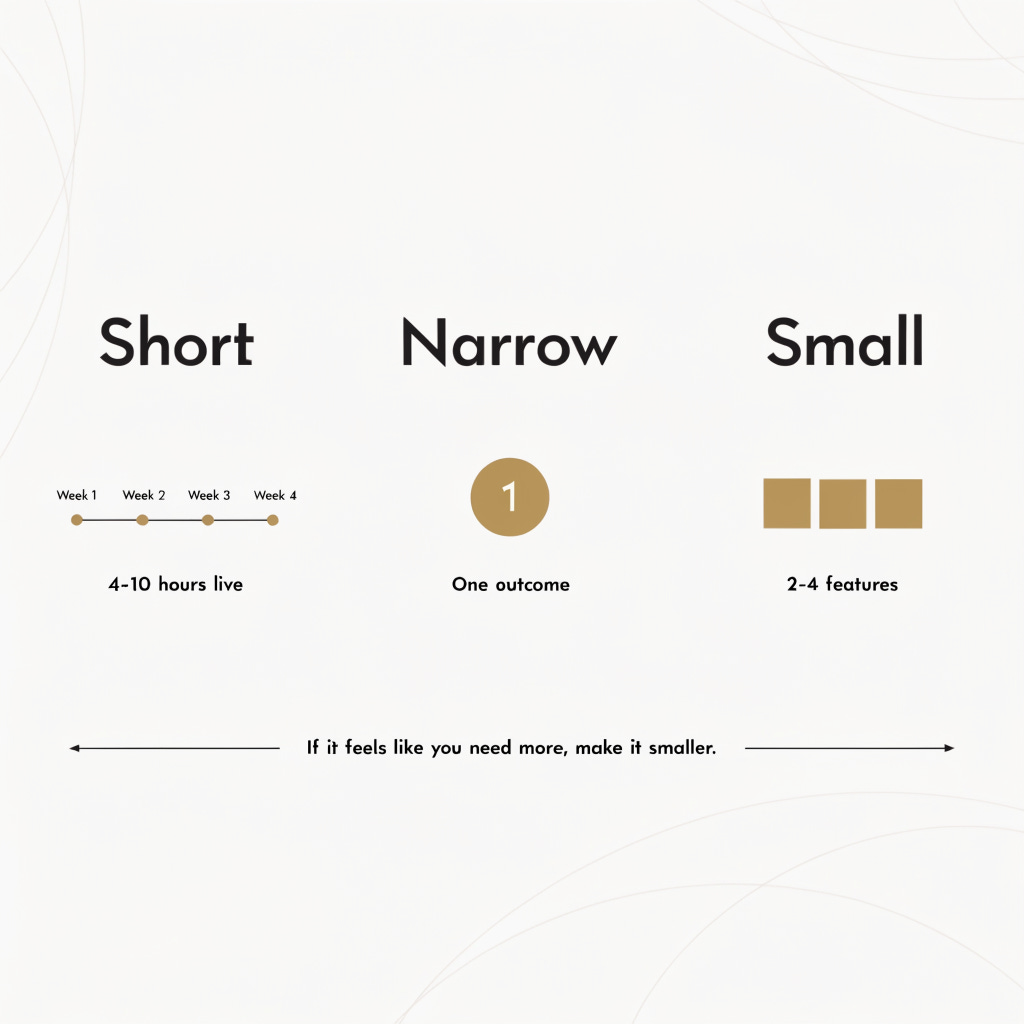
The second principle is what I call Short, Narrow, Small.
Short means four to ten hours of live content delivered across two to four weeks. Narrow means you solve one problem and deliver one outcome. Small means you include only two to four core features: live sessions, a handful of resources, homework assignments, and a community space. That is it.
The instinct most people have is to add more. More modules, more bonuses, more content, more weeks. That instinct will destroy your cohort. The single greatest reason people abandon educational products is information overload. People feel good when they complete something. Your cohort’s entire job is to be completable. If you feel the need for more sessions or a longer timeline, you are teaching too much. Make it smaller.
The third principle is systems over curriculum.
Here is the truth that most educators resist: people do not want to learn. They do not care about your cohort, your framework, or your teaching style. They care about the result. Your job is to make the path to that result feel as close to done-for-you as possible, even though it is not a done-for-you service.
The way you do this is by building shortcuts into every step. Templates that are 80 percent complete so students only fill in the remaining 20 percent. AI prompts that generate first drafts they can edit rather than stare at blank pages. Checklists that eliminate decision fatigue. Examples pulled from real results so students can model their work on something proven rather than creating from scratch.
The best cohorts do not just teach. They hand people a machine that does most of the heavy lifting for them. That is what makes the difference between a student who understands the material and a student who actually executes it.
The fourth principle is sell before you build.
You do not need a completed curriculum to launch a cohort. You need an outline, an orientation video, and a clear description of the outcome. Sell the first cohort on that basis. Build the detailed slides and session content after you have confirmed there is demand.
This is one of the most powerful features of the cohort model: it has a built-in pre-sale mechanism. Because sessions are live and scheduled in the future, people must buy before the program begins. You validate demand before you invest the time to build. If nobody joins the waitlist, the concept or value proposition needs work. If people sign up, you build with confidence knowing real humans are waiting for what you are creating.
I spent four months designing my program before I launched the first cohort. I pressure-tested every component against twenty years of experience building and running programs at Google, Deloitte, and across government, healthcare, and enterprise technology. You do not need four months. But you do need to understand that a cohort is not something you throw together over a weekend. It is a structured system designed to produce a specific outcome. Treat it that way and the results will follow.
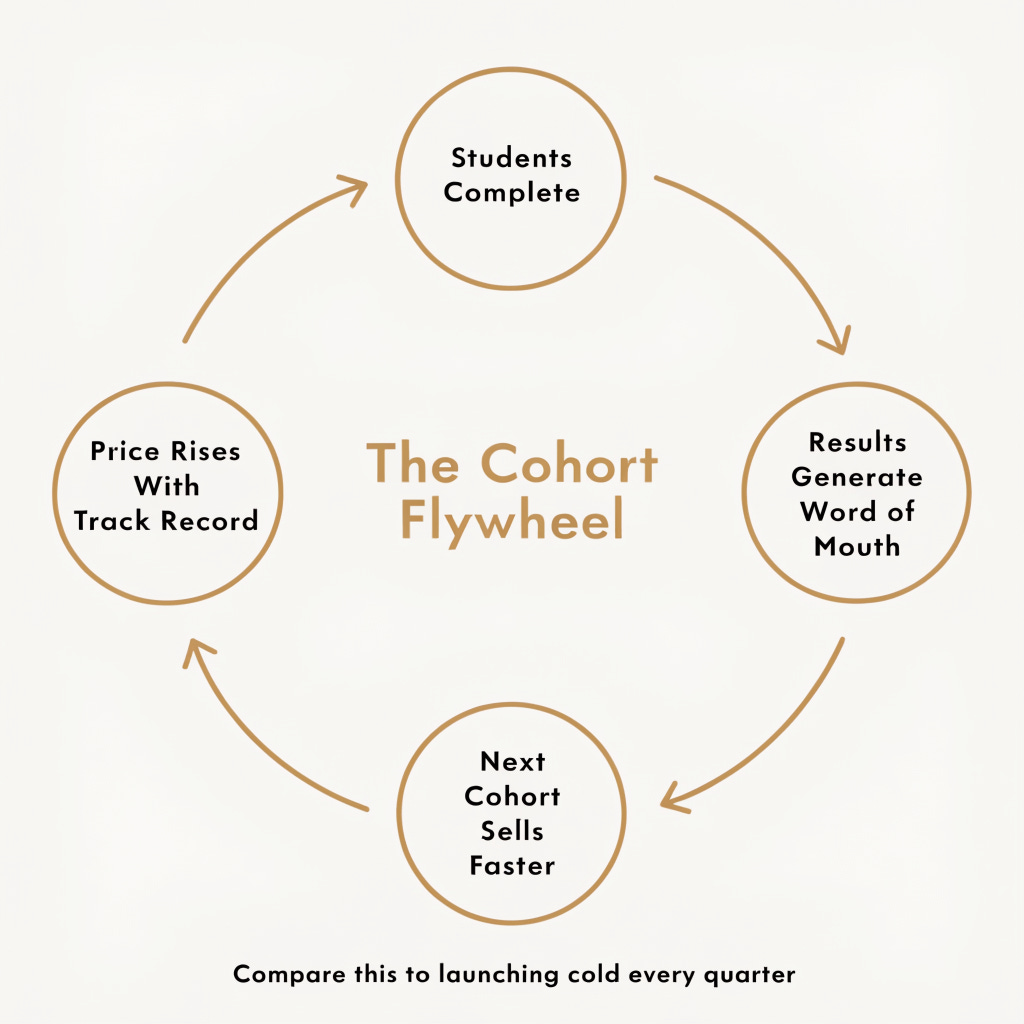
There is a flywheel embedded in this model that most people do not see until they experience it.
When your students complete the program, they get results. When they get results, they tell other people. When other people hear about it from someone they trust, your next cohort sells faster with less effort. When each cohort sells faster, you can raise the price because the product has a track record. When the price rises alongside demand, you have a real business, not a launch treadmill.
Compare that to the traditional course model. You spend months creating content. You launch it. Five percent of buyers finish it. Almost none of them get the result. No one recommends it. Your next launch requires the same cold outreach, the same ad spend, the same exhausting promotion cycle. The format itself is working against you.
A cohort reverses that dynamic entirely. Better outcomes lead to organic demand. Organic demand leads to sustainable pricing. Sustainable pricing leads to a business you can actually run without burning yourself out every quarter.
The market conditions supporting this shift are not going to reverse.
AI has made information functionally free. YouTube has made instruction functionally free. What remains scarce is structure, accountability, human interaction, and the kind of guided environment that makes people actually do the work they have been putting off. That scarcity is real, it is growing, and it is exactly what a cohort provides.
The people who recognize this early are building the next generation of education businesses while everyone else is still trying to sell pre-recorded content into a market that has moved on.
I have run two cohorts of my own program so far, and our successful candidates make their first sale within 30 days. I am not sharing theory. I am describing what I do on nights and weekends while still working full-time leading AI programs at Google. The model works because the format itself drives the outcomes. Not motivation, not content quality alone, but the structural mechanics of shared timelines, live interaction, and peer accountability doing what willpower never could.
If you have been sitting on expertise you know is valuable, if you have considered building a course or an info product but something about it has never felt right, if you have watched the market shift and wondered where the real opportunity is heading next, this is the direction it is moving.
I put together a free blueprint that walks through the complete system for building a cohort-based course from scratch, including the structure, the launch timeline, the marketing sequence, and the templates I use in my own program. You can get it at guneytopcu.com/cohortblueprint.
The window on this is open right now. The format is proven, the tools are accessible, and the market is ready. The question is whether you move on it while the space is still uncrowded or whether you wait until everyone else has figured out what you are reading right now.
Until next Monday,
Guney


